
Guided tours
Twelve narrated journeys across six pillars. Each tour stages its mechanism in 3D on real structures — scenes play themselves while NEXT, BACK, and EXIT steer you.
Pillar 0
Introduction to Biotechnology
Learn to read molecules before exploring them.
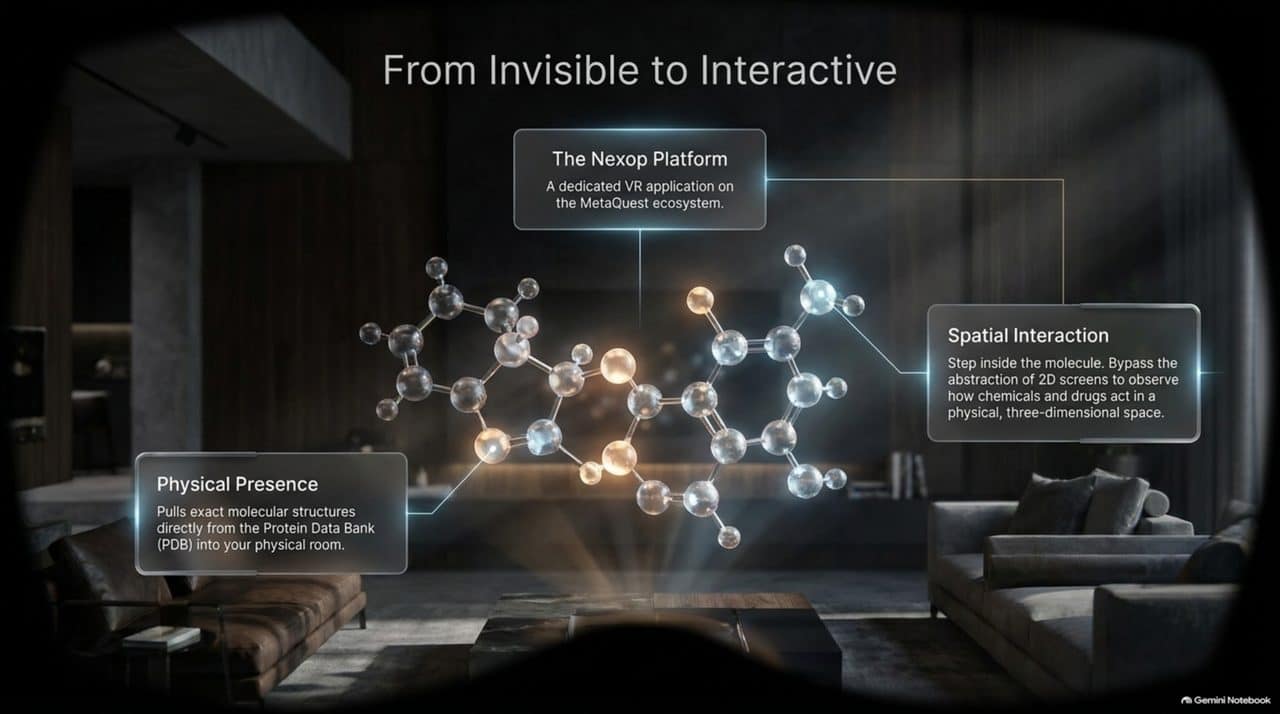
Intro to Structural Biology
How to read molecules: beads, pockets, gene to chain, and AI folding.
14 scenes · PDB 1AKI, 2PTN
Structural biology reads molecules in 3D: shape decides job. Proteins are chains of twenty amino-acid beads that fold into precise machines — shown on lysozyme (PDB 1AKI). Meet three famous beads and their talents, find the pockets and catalytic trios where work happens, trace a gene becoming a chain, and see how AI predicts a fold from bead order alone.
- Proteins as bead chains; His, Tyr, Leu talents
- Active sites and the Ser-His-Asp catalytic trio
- Gene → mRNA → chain; H-bonds stitch the fold
- Cartoon vs ball-and-stick styles; AlphaFold preview
Pillar 1
Foundations of Life
Energy currency and oxygen delivery.
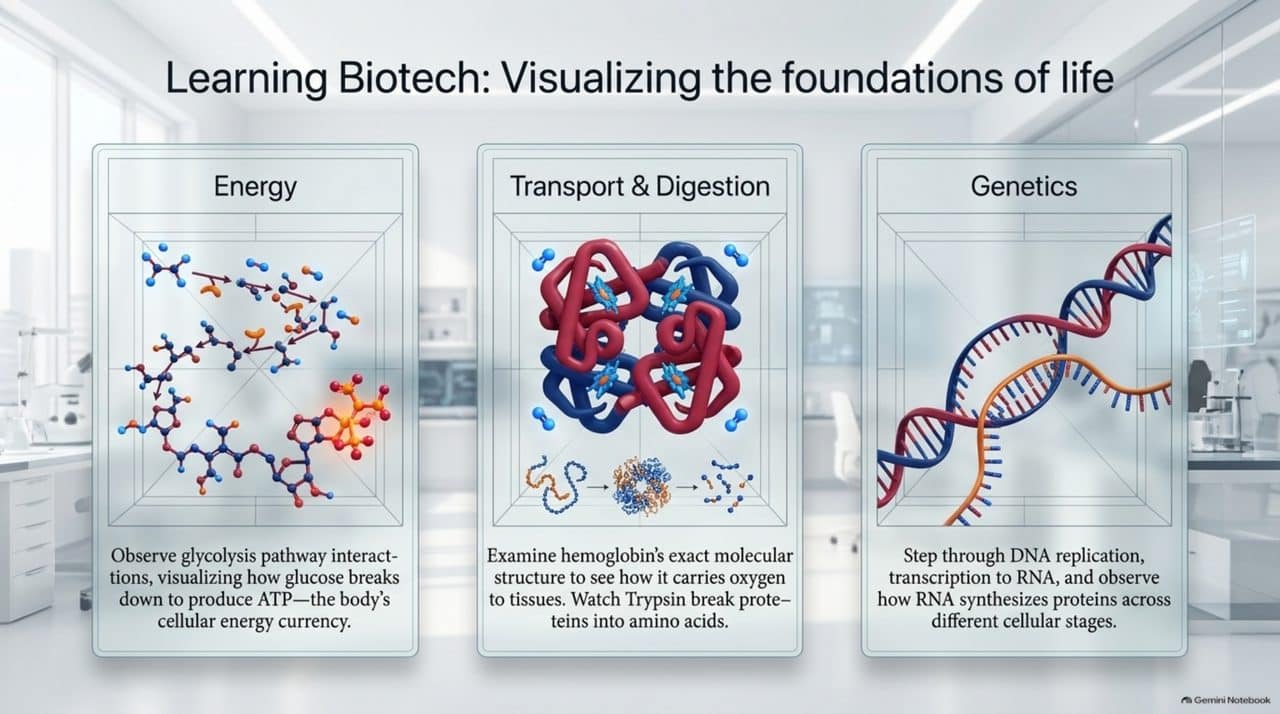
ATP — The Energy Currency
A loaded chemical spring: snap off a phosphate, power the cell.
9 scenes
Every cell runs on ATP — an adenine base, a ribose sugar, and a tail of three phosphates. Think of that triphosphate tail as a loaded chemical spring: when the cell needs energy, a water molecule attacks the last phosphate bond and snaps it off, releasing the energy that powers muscles, nerves, and all cell building work.
- Adenine + ribose + triphosphate architecture
- Hydrolysis: water attacks the gamma phosphate bond
- ATP → ADP + phosphate energy release
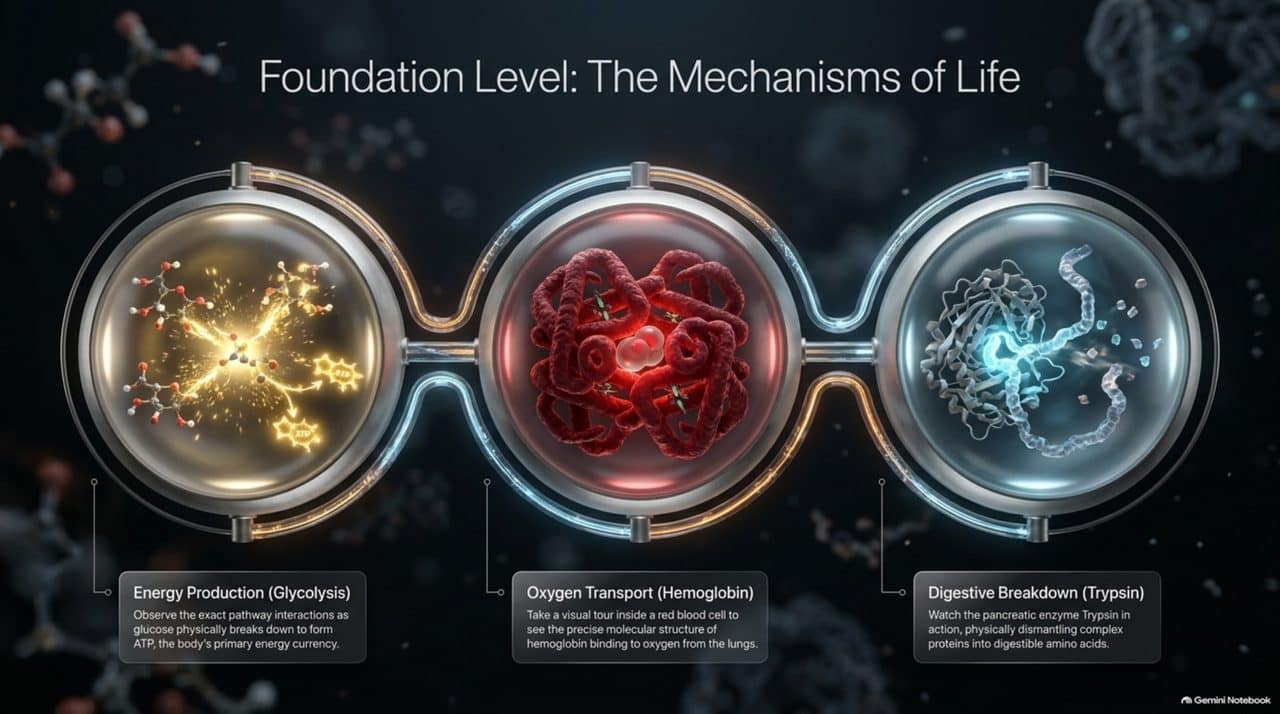
Hemoglobin — The Oxygen Delivery Team
T to R loading, the Bohr drop-off, and the CO₂ return trip.
9 scenes · PDB 2HHB, 1BBB
Hemoglobin is the oxygen taxi of the blood: four protein chains, each holding one heme with one iron — four seats per taxi. Shown empty in the tense T-state (2HHB) and loaded in the relaxed R-state (1BBB). In the lungs the first oxygen snaps the taxi relaxed and the other seats fill at once; in tissues the Bohr switch spills the oxygen out, then hauls CO₂ home.
- Tetramer: 2 alpha + 2 beta chains, 4 hemes
- Cooperative loading: T-state → R-state snap
- Bohr effect: acid + CO₂ trigger oxygen release
- CO₂ return, parked mostly as bicarbonate
Pillar 2
Pathways & Interactions
Metabolic engines and molecular scissors.
Glycolysis — The Ancient Engine
Glucose → ATP + NADH + pyruvate, no oxygen needed.
11 scenes
Glycolysis is the oldest metabolic engine on Earth: 3.5 billion years old, needing zero oxygen. Glucose gets primed with two phosphates and split into halves; GAPDH steals electrons onto NAD and builds energy-rich 1,3-BPG; finally PGK snaps the phosphate across to recharge ATP — while the PFK master switch reads the room.
- Priming, splitting, and payoff phases
- GAPDH dyad: Cys152/His179 electron theft
- PGK recharges ATP on magnesium holders
- PFK regulation: AMP/ADP vs ATP/citrate
Trypsin — The Gut's Protein Scissors
A catalytic triad slices food proteins right after Lys and Arg.
11 scenes · PDB 2PTN
Your pancreas brews trypsin as a harmless blueprint called trypsinogen, then a gut-wall enzyme clips the safety block off to arm it. Active trypsin cuts food proteins in exactly one place: right after lysine and arginine. A deep S1 pocket with an Asp189 magnet grabs those targets while the Ser195-His57-Asp102 triad slices the bond.
- Trypsinogen activation by enteropeptidase
- S1 pocket specificity for Lys/Arg
- Catalytic triad cleavage, atom by atom
Pillar 3
Medicine: Drugs & Vaccines
Watch drugs sabotage, jam, and rescue.
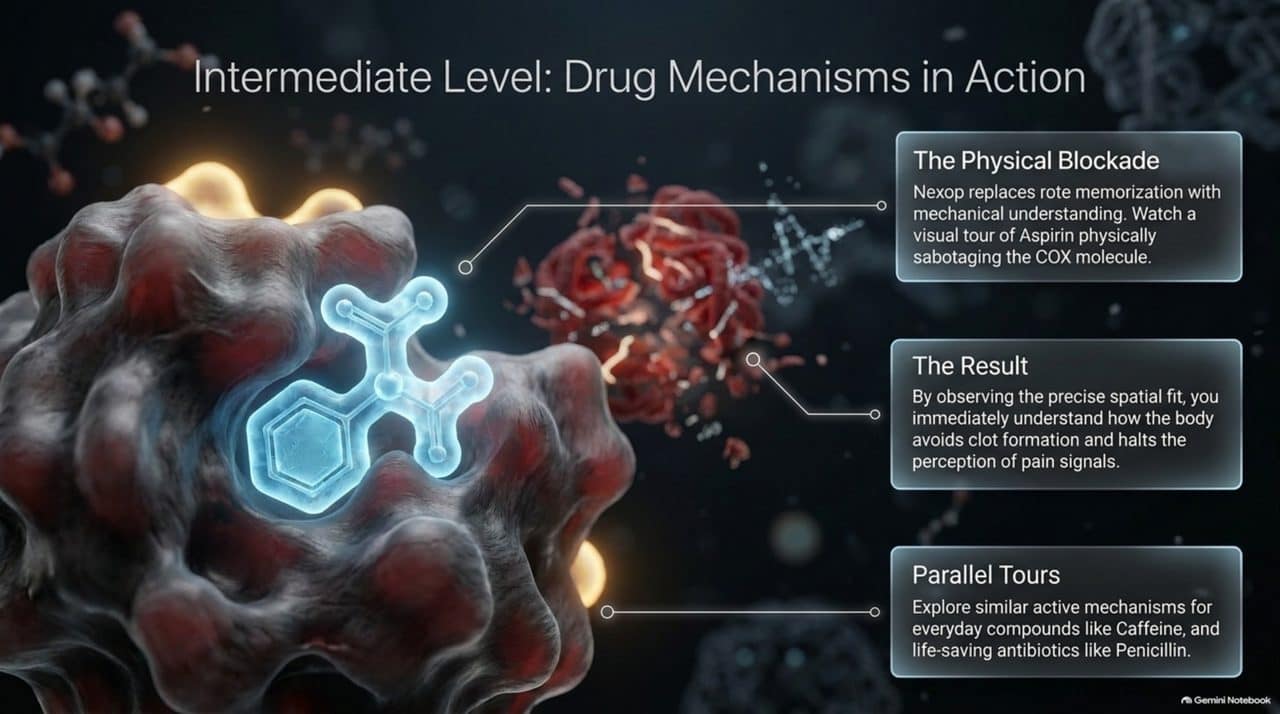
Aspirin vs COX — The Suicide Blocker
One acetyl cap on Ser530 jams pain, fever, and swelling.
9 scenes
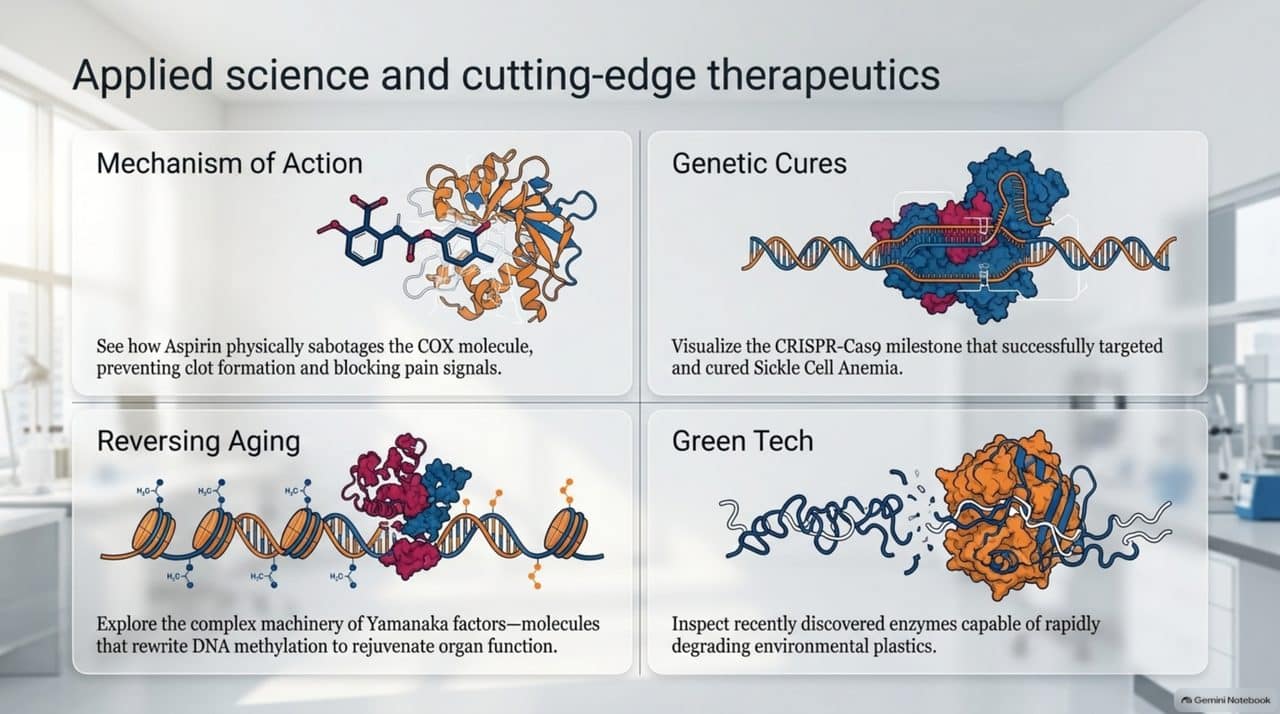
When you get hurt, cells build COX-2, which turns arachidonic acid into prostaglandins — the signals for pain, fever, and swelling. Aspirin is a suicide blocker: it slips into the COX channel and permanently caps Ser530 with an acetyl group, jamming the machine so no prostaglandins get made.
- COX-2 channel: doorway, spark plug, bullseye
- Aspirin acetylates Ser530 — permanently
- No prostaglandins: no clots, no pain signals
Caffeine — How Coffee Postpones Sleep
An A2A lock jam plus liver cleanup by CYP1A2.
9 scenes · PDB 5MZP, 2HI4
Caffeine postpones sleep by borrowing a lock, not by making energy. Adenosine plugs the A2A sleep lock (5MZP) and slows the brain — caffeine fits the same seat but never flips the switch, so you stay awake. Then the liver enzyme CYP1A2 (2HI4) clips off caffeine’s three methyl bumps, and the backed-up adenosine brings sleep back.
- A2A receptor: adenosine flips the Trp246 switch
- Caffeine occupies the seat without switching
- CYP1A2 heme clips methyls → paraxanthine et al.
Penicillin — The Suicide Decoy
A beta-lactam rail jams PBP — the bacterium explodes.
9 scenes · PDB 1VQQ
Penicillin sabotages the PBP2a enzyme (1VQQ) that welds the bacterial wall — so the wall stops growing and the bacterium explodes under its own pressure. Penicillin’s strained beta-lactam ring mimics a wall rail, slips into the pocket, and lets Ser403 snap it into a permanent covalent choke — while human cells go unharmed.
- PBP2a transpeptidase welds D-Ala-D-Ala rails
- Beta-lactam mimicry + Ser403 covalent trap
- Torn mesh → flood → lysis; humans unaffected
tPA — The Stroke Lifesaver
One clipped bond turns plasminogen into a clot-shredder.
9 scenes
An ischemic stroke is a fibrin clot blocking a brain artery — and neurons die by the minute. IV tPA docks onto fibrin and its serine protease triad clips exactly one bond, flipping sleeping plasminogen into plasmin. Plasmin shreds the fibrin ropes into harmless D-dimers and blood flows again — if doctors beat the 3 to 4.5 hour clock.
- Fibrin clot traps sleeping plasminogen
- tPA clips Arg561–Val562: plasmin awakes
- Fibrin shredded to D-dimers; race the clock
Pillar 4
Genetic Technologies
Editing and rewinding the code of life.
CRISPR-Cas9 — The Gene-Editing Scissors
Guide, PAM password, R-loop — then two blades fire.
10 scenes · PDB 5F9R
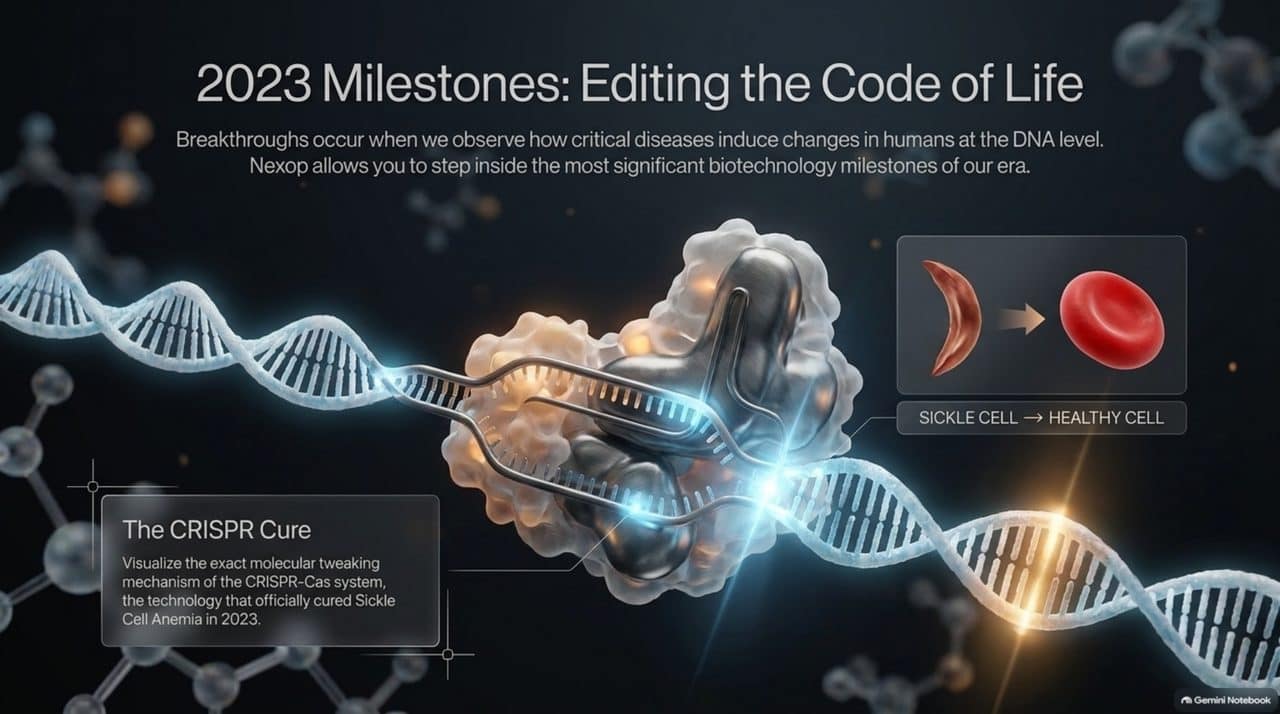
Bacteria invented Cas9 as an antivirus; scientists reprogrammed the guide to target human genes — and in December 2023 the FDA approved Casgevy, a CRISPR cure for sickle cell disease. Watch Cas9 (5F9R) dock its guide, scan DNA for the NGG password, unzip an R-loop, and fire two blades: the HNH trio and the RuvC cage.
- Guide RNA + NGG PAM recognition
- R-loop unzip; HNH and RuvC blades
- 2023 milestone: sickle cell cure approved
Yamanaka OSK — Rewinding the Blind Eye
Pioneer factors pry chromatin open; TET2 shears methyl tags.
9 scenes · PDB 4NM6
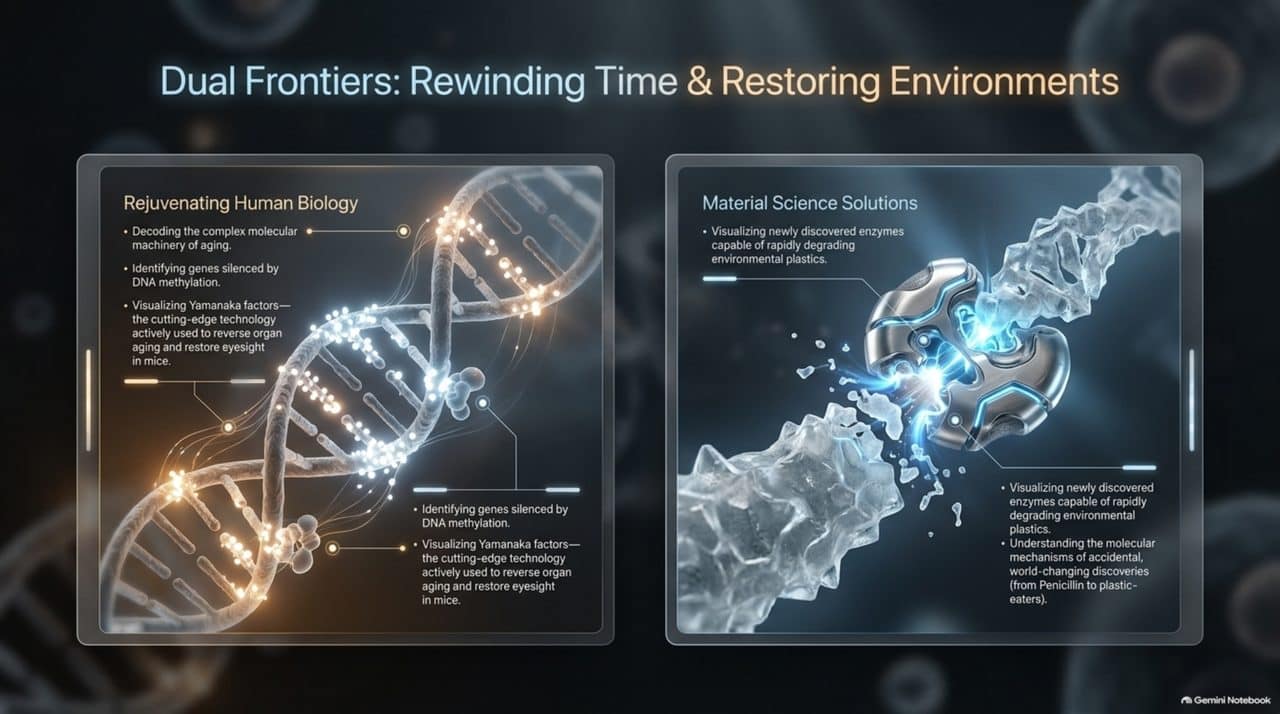
Aging blinds the eye without breaking a single DNA letter: methyl bookmarks drift and lock retinal genes inside silent chromatin. Delivered Yamanaka factors Oct4-Sox2-Klf4 pry the nucleosome vault open; then TET2 (4NM6) cradles one iron atom and shears the methyl tags off. Clock reset, axons regrow, vision returns.
- Methylation silences genes without mutations
- OSK pioneer factors open the vault
- TET2 demethylation resets the clock
Pillar 5
Biotech & Material Science
Enzymes that eat plastic.
PHL7 — The Plastic Demolition Team
A compost-heap enzyme that zips down PET chains.
10 scenes
In 2022, scientists found plastic-eating PHL7 in a compost heap. Warmed to 70°C, soft plastic chains slide into its groove, a hydrophobic clamp locks the flat plastic ring in place, and a catalytic triad (Ser131, Asp177, His209) snips the chain apart. The products dissolve away and can be rebuilt into brand-new bottles.
- Subsite I hydrophobic clamp grips PET rings
- Catalytic triad snips chains with water
- TPA + EG recycled into new bottles
12 tours today — and more chapters on the way, including cellular energy cycle, COVID spike and mRNA vaccines, DNA replication, transcription and translation. Ready to step inside? Get NexoPeek on Meta Quest.